
A fractional executive is a part-time employee performing some of the work of an executive, or all of the work of an executive for a defined term. In an era where cost-conscious leaders are trying to avoid taking big risks, even at venture-backed companies, this arrangement is growing in popularity, especially for CFO and CMO roles.
Since 2018, the share of new executive positions mentioning fractional work has increased by more than three times, according to data shared with Newsweek by Revelio Labs, a workforce analytics firm.
“This is quite a big increase,” Anna Airoldi, an economist at Revelio Labs, told Newsweek. “There has definitely been an increase in the trend in the past five years or so, especially after COVID.”
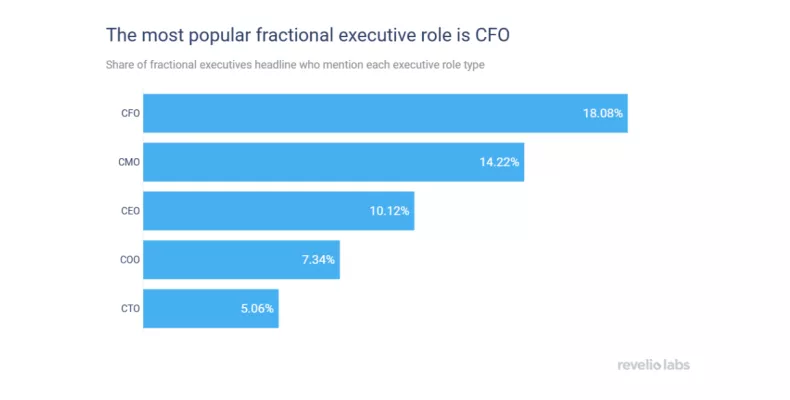
Revelio Labs’ research also found that fractional executives are more likely to be women, and that CFOs (18 percent) and CMOs (14 percent) are the most prevalent executive roles for fractional work.

Nancy Smith, chief marketing officer at Swippitt, a consumer technology company, started as a fractional leader for the company in June. She told Newsweek she appreciated the flexibility and freedom of working as a fractional leader.
“I don’t have to jump in and put all my eggs in one basket, which is nice,” Smith explained.
Though the relationship can straddle the line between consultant and employee, employers benefit from the skills and connections of someone with high-level experience, with a fraction of the price tag. Smith says it allows for more honesty in the early part of the working relationship as well.
“I was able to be a lot more honest than I have [been] when I’m on the executive team, and I’m worried about how it might come off,” she said. “There’s a lot more clarity and freedom associated with being part of an executive team [fractionally].”
Padraic Connolly, CEO of Swippitt, which launched at CES in January, told Newsweek he valued Smith’s experience at iRobot, where she helped build the Roomba brand and served as vice president of global marketing until 2014. She worked as a chief marketing officer at three companies over the next six years before starting to work in consultative and fractional roles.
Connolly added that working with fractional leaders has taken a lot of risk out of leadership hires as the company progresses through different stages of growth. He’s hired fractional leaders in finance, manufacturing, strategy and product leadership roles.
He observed that VCs and investors used to push back on the idea of hiring in this way, but now “it’s become the norm” as startups have become “a lot more conscious and sensitive about capital.”
“For startups, any hire is a high risk. Fractional is a way to bring in renowned leadership and get that immediate impact without having to get into large contracts,” Connolly shared, pointing to high salaries and demands for equity for early executive hires. He also said a fractional hire can act as a “long interview,” as it did with Smith.

Execs React to Labor Market Instability
Caleb Bushner was working as a head of marketing when his company instituted a strict return-to-office policy. He had a 2-month-old newborn and had moved to a new home where his growing family could have more space. After the RTO mandate, he decided to leave the company.
“There’s no way I was going to do 9-to-5, five days a week again,” he told Newsweek. What he found, though, was a highly competitive market for full-time work.
“Every week, it feels like there are a thousand Big Tech people with the same résumé as me getting laid off, entering the job market,” he said.
As a former tech marketing leader, Bushner was working at a marketing agency when he realized that some of his senior-level peers at the agency could create their own books of business rather easily during the “SaaS revolution” of that time.
“We no longer needed an agency to find work, and just cut out the middleman,” he said. If you’re good, “you can make more money and pick the exact work you want.” Like Smith and Connolly, he emphasized the risk mitigation and cost-saving opportunity of this path, while still bringing in valued expertise.
“Marketing is a notorious cost center—it was ripe for more efficiency-minded attention from the CEO and CFO,” Bushner said. CMO is also a position that has among the shortest tenures across the C-suite.
He added that fractional work reduces pressure on his end as well.
“When I get hired full time, the feeling is I need to be there for four years,” he explained.
Crystelle Desnoyer worked as a chief of staff at Techstars and Kyndryl. She’s worked as a fractional operations leader across multiple freelancing stints and eventually developed a niche in corporate event planning after identifying a need to specialize.
She told Newsweek that in 2023, when she first started freelancing, she noted the hundreds of thousands of people in the tech world being laid off and “a startup job market in chaos.”
She said she felt that her generalist skill set was not well-suited for that time, and investment in growth-stage companies would be minimal, so she freelanced while searching for full-time work.
During that time, she developed her niche in event planning, organizing over 20 conferences, webinars, panels and virtual events in the span of a year. She still takes on fractional operational roles as well.
“I had a strong enough network for them to give me a project, and then you build that system,” she explained, adding that her business comes exclusively through word-of-mouth referrals.
Desnoyer credits her networking ability as well as her experience in startups for helping her view her own employment like a startup itself. Like many freelancers, she notes late client payments, health care and retirement savings as challenges to her new working arrangement.
Rightsizing Growth-Stage Leadership
Fractional leadership might be a more appropriate way to compensate top-tier leaders, who are used to commanding large salaries and equity packages at major companies.
In bootstrapping or early-stage venture-backed companies, cutting into the equity pie for an executive hire is a large risk. Smaller companies inherently pay a higher organizational cost of executive turnover.
Connolly emphasized the opportunity to bring in talent with experience from the world’s top companies.
“Fractional leadership offers immediate impactful action from execs who, on their agreed hours, step in and get the work done of a leader, as opposed to someone who comes in a couple hours a week and pushes in a direction or makes some suggestions for a couple of weeks,” he said.
This labor market is working on both ends because companies are willing to be more cost-conscious and the executives have an interest in diversifying their portfolio, either for reasons of interest or personal growth, or some combination.
“I can be really choosy about [job opportunities],” Smith said.
Bushner said fractional work has allowed him to develop into a more complete marketer and marketing leader, particularly in emerging areas such as AI, because of the opportunity to work with multiple companies.
“Hiring a fractional leader is good for an organization that recognizes that they have a need at the leadership level, but can’t afford the whole enchilada,” he said. “This era of tightened belts requires a new approach.”